Praying Feet and Praying Lips - Yom Kippur 5787
Earlier this year I was sent an Instagram video from a congregant with the message, "we need to fix this." The video, from a comedian named Antonia Lassar, shows her at a synagogue standup show asking a group of Reform Jews, "who here knows the Torah portion this week." No one answers. No one knows.
Lassar jokingly conducts an experiment. She follows up with another question, "Who here knows how to contact their state representative." Every hand goes up. Amid a mixture of proud and embarrassed laughter, Lassar points at the crowd and triumphantly proclaims, "The Reform Judaism I know!"
Watching this video, I found myself agreeing with the congregant who sent me the clip. If this is Reform Judaism, then we have lost our way.
Now, before I go on, I want to say that I'm convinced if Antonia Lassar were to show up at this congregation and ask the same question, we would have plenty of people who would answer her.
I also want to say that I'm proud of so much of the social justice work our congregation has done over my time at TNT. My problem is not with social justice per se, but rather with the balance I see out in the Reform movement between those social justice initiatives and every other aspect of Jewish life and practice.
And I think we are out of balance for three reasons:
First, speaking about and doing social justice is just easier and more approachable than the thornier stuff of Judaism: figuring out what you believe about God, why evil happens, how to make prayer feel meaningful. I confess, sometimes I speak about ethics because I don't have to spend the time parsing my words carefully as I might when I talk theology.
Second, social justice is more pervasive in our society. If we want to find out what's wrong with the world, we can just turn on the news. We know much more about the ills around us than we do the intricacies of the Jewish calendar or Jewish law. Unlike politics, we don't get that information through osmosis.
Third, when we do social justice, we know people will show up. Every year we struggle to get a handful of people to our Tisha B'av commemoration. It's a tough sell to get people in the middle of the summer to mourn the destruction of the First and Second Temples in Jerusalem. But when we move our service to Delaney Hall and link the holiday to the plight of modern immigrants, we pack that space. That's not to say that we went to Delaney Hall only because of numbers or that the evening wasn't moving. But it does show how much easier it feels for us to show up for justice than grief, text, or prayer.
Before going further, it's helpful to see how we got here:
Reform Judaism is a little over 200 years old. Early on, in Germany, the movement had a number of hallmarks, including a focus on ethics. But despite what many think, these ethics were mostly interpersonal: not gossiping, not stealing, paying workers on time, etc. They were not grand social justice principles.
That began to change toward the turn of the 20th century. Once Reform Judaism arrived in the United States, Reform Rabbis felt the need to codify what Reform Judaism stood for and wrote the first platform for the movement in 1885 called the Pittsburgh Platform.
Interestingly, the bulk of the platform was written by a Rabbi named Kaufmann Kohler and never mentioned social justice. Only later, before it was going to be voted on, did another Rabbi, Emil G. Hirsch, add a clause that implored Reform Jews "to solve, on the basis of justice and righteousness, the problems presented by the contrasts and evils of the present organization of society."
Emil was out of step with where the rest of the movement was but held their feet to the fire and that clause planted a seed that would blossom in later generations.
By the 1920s Jews had been living among non-Jews in America long enough to fully absorb and embody the American Progressive and the Protestant Social Gospel movements. At first the Reform movement didn't even try to make their progressivism look Jewish. The Reform Rabbinate passed their first true social justice initiative, advocating for a minimum wage and the 8-hour-day, without mentioning a single Jewish text. Within a decade the Reform movement was passing all sorts of resolutions indicting capitalism and calling for morally responsible investing and finding ways to link them to Judaism. And later, many Reform Jews found their social justice voice especially in the 1960s and 70s during the civil rights and anti-Vietnam eras.
One of the reasons for this emphasis on social justice was that until the 1970s, Reform Judaism didn't have much besides ethics to stand on. They had gotten rid of ritual, stopped praying in Hebrew, dropped kashrut, and complicated notions of Jewish peoplehood. The past fifty years have been a long, slow process back to embracing the distinctive traditions that make Reform Judaism, Jewish.
The reason I worry about our current approach to social justice is that it often feels rootless, reductive, and overshadowing. So to fix it, we need a social justice that is rooted, nuanced, and balanced.
First, rooted.
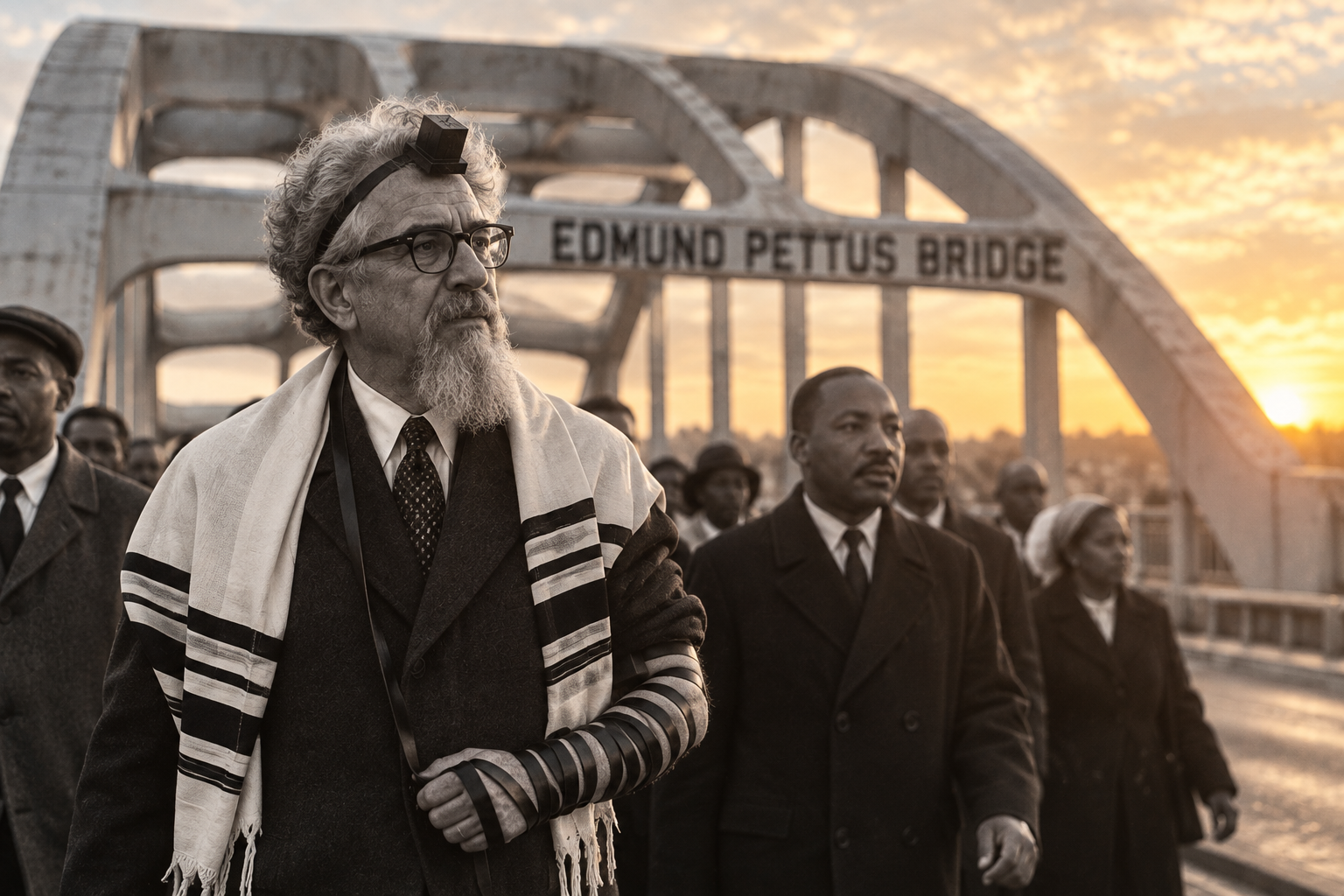
We Reform Jews love to quote Rabbi Abraham Joshua Heschel who said that when he marched in Selma with Martin Luther King Jr., he felt like his "feet were praying." For anyone who has ever done justice work, Heschel's metaphor should ring true. There can be real spirituality in advocating for a better world.
But most forget that Heschel was able to have praying feet because he was practiced in using praying lips. I have no doubt that the morning he marched over the Edmund Pettus Bridge, he studied Talmud, said the Shema, and even wrapped tefillin. And it was carrying those things with him as he marched as a Jew that made that walk matter spiritually.
His activism wasn't a substitute for his Judaism. It was an expression of it, rooted in decades of study and practice that gave his advocacy depth and its distinctly Jewish shape. Not only did being a committed Jew bring him credibility as he spoke for his faith, but it grounded him in the "why" of justice work. And as Viktor Frankl has taught us, "he who has a why can bear any how."
Next, nuanced.
Judaism is inherently political. Read the prophets who speak truth to power. Open the Torah and learn how to take care of the most vulnerable. Politics is the avenue for making a better world, and Judaism does not ask us to sit out that conversation.
But Judaism is not synonymous with a political party. Judaism is a three-thousand-year-old religion of contradictions. It tells us to take care of the other and take care of ourselves. It tells us to take a long view of the future but not at the expense of our children's wellbeing today. It tells us to welcome the stranger, and it tells us to guard our own borders and boundaries.
The Jewish view of any given social issue is nuanced and likely up for dispute. The Jewish view of climate change, immigration reform, or social welfare is slippery. Most are the subject of millennia old debates. Feel free to choose a side but know what arguments you are rejecting and respect that someone may come to a different conclusion using Jewish texts that shows as much integrity in their thought process as you do.
Too many Reform Jews take the easy way out. Rather than do a deep dive into the tradition and risk learning their deeply held views run against some Jewish grain, they make Judaism synonymous with the aims of the Democratic or Republican party, mapping fully their understanding of this rich and complicated religion onto partisan politics.
Finally, balanced.
It often feels when looking at the modern Reform movement that Judaism is entirely synonymous with social justice.
The only conversion student I've ever parted ways with was over this very issue. As part of the conversion process, I require students to attend services twice monthly, read books about Jewish history and practice, and dabble in the most basic level of kashrut, giving up pork and shellfish. Most do this enthusiastically, but one student refused. He wasn't interested. When I asked him what he does that is "Jewish" he answered me, "I'm a good person. Isn't that enough."
I think about that answer a lot. Because there are real risks in that worldview. Foremost, being a good person isn't distinctly Jewish. Kashrut is. Praying in Hebrew is. Shabbat is. But you don't need to be Jewish to care about poverty, fight for immigrant rights, or stand against climate change. Many faiths and philosophies do. And if I'm going to honest, some even do it better than us.
Imagine that Jewish life is a beautiful dish and all its component parts are ingredients. Social justice would be salt. It certainly adds to the dish and sometimes a dish is lacking without it, but it's certainly not a meal on its own.
Add to that the fact that if we want our children to want to pass Judaism on to the next generation, we need to instill in them many more Jewish memories than marches and protests. They may matter to you but are not enough to hold a people together.
So what can we do to fix this?
More than anything else, if social justice is easy then make it more complicated. And if the rest of Judaism is hard, find ways to make it easier.
In practice this means that you should first question your assumptions about social justice. If you don’t have the knowledge in your hand, use the technology at your fingertips. Jewish research has never been simpler. I’ll give you an AI prompt:
I have heard that Judaism tells us to take care of the stranger and protect the immigrant. Give me five Jewish texts that support that stance and at the same time give me an equal number of texts or principles in Judaism that complicate that notion.
When you do, you will get the greatest hits: Love your neighbor as yourself; Care for the widow, orphan and stranger because you were strangers in the land of Egypt, etc.
At the same time, you will get the Talmudic notion that “the poor of your own city take precedence” over the stranger (Bava Metzia 71a) or the notion that the word “ger” which we often translate as stranger comes with certain expectations and you are only required to care for them if they act as part of your community.
Let the tensions sit. Then come up with your conclusions. If in the end you end up in the same place, then at least you would have arrived at your position with more fidelity toward the tradition.
On the flip side, use those same tools to help you make the rest of Judaism more accessible. If you don’t know the Friday night kiddush, play a YouTube video and sing along until you do. When you are driving and bored in the car, turn on the chat feature on Claude and discuss a Jewish question you’ve always wondered about. When a family member asks you what you want for your birthday or Hannukah, tell them to surprise you with a Jewish book so you have one laying around when you are looking for something to read.
If you let it, the rest of Judaism can be as pervasive as social justice. Studies have shown that the number one factor that makes a child decide to raise a Jewish family one day is the number of Jewish family friends their parents had as they grew up. That’s because when you surround yourselves with Jews, you will stumble into Jewish conversations, holidays and Shabbat will be an excuse to gather, and one of you will actually read our ungodly long e-blast and realize there is a great program that all of you might enjoy.
And let Judaism do double duty. Part of the reason we love politics is that it scratches a moral itch for us. We want to be good people. Politics and engagement with social justice is the stick by which we measure whether we are living up to that ideal.
But morality is not the only measure of a person. Shabbat can help you fulfil your desire for more family time. Torah or Talmud study can help you use a different part of your brain than you might at work. Prayer can keep you spiritually grounded in a world that too often feels surface.
I want to help you with all of that. On your seats, we have a list of all the classes and events that you might come to this fall. A few are related to social justice, but most engage other parts of your Jewish identity. Commit to come to one more class or lecture than you did the year before.
And I want to reiterate my challenge from last night. Read a Jewish book. If you do, and you get one other person to read it alongside you, I promise to read it too this year and meet you for coffee to discuss it.
One of the most famous phrases in all of Judaism is:
Al Shelosha D’varim - The world was built on three things: learning, prayer, and acts of loving kindness.
A one-legged stool cannot stand. A two-legged stool is shaky. But a three-legged stool is firm.
If our problem today is an unrooted, unbalanced, unnuanced Judaism, then the answer is to double down on all that makes Judaism rich and wonderful. Don’t let go of your desire to make this broken world whole, but do it better: rooted in tradition, balanced with prayer and study, nuanced among the many diverse Jewish voices past and present.