Gradually then Suddenly - Rosh Hashanah Day 1 (5787)
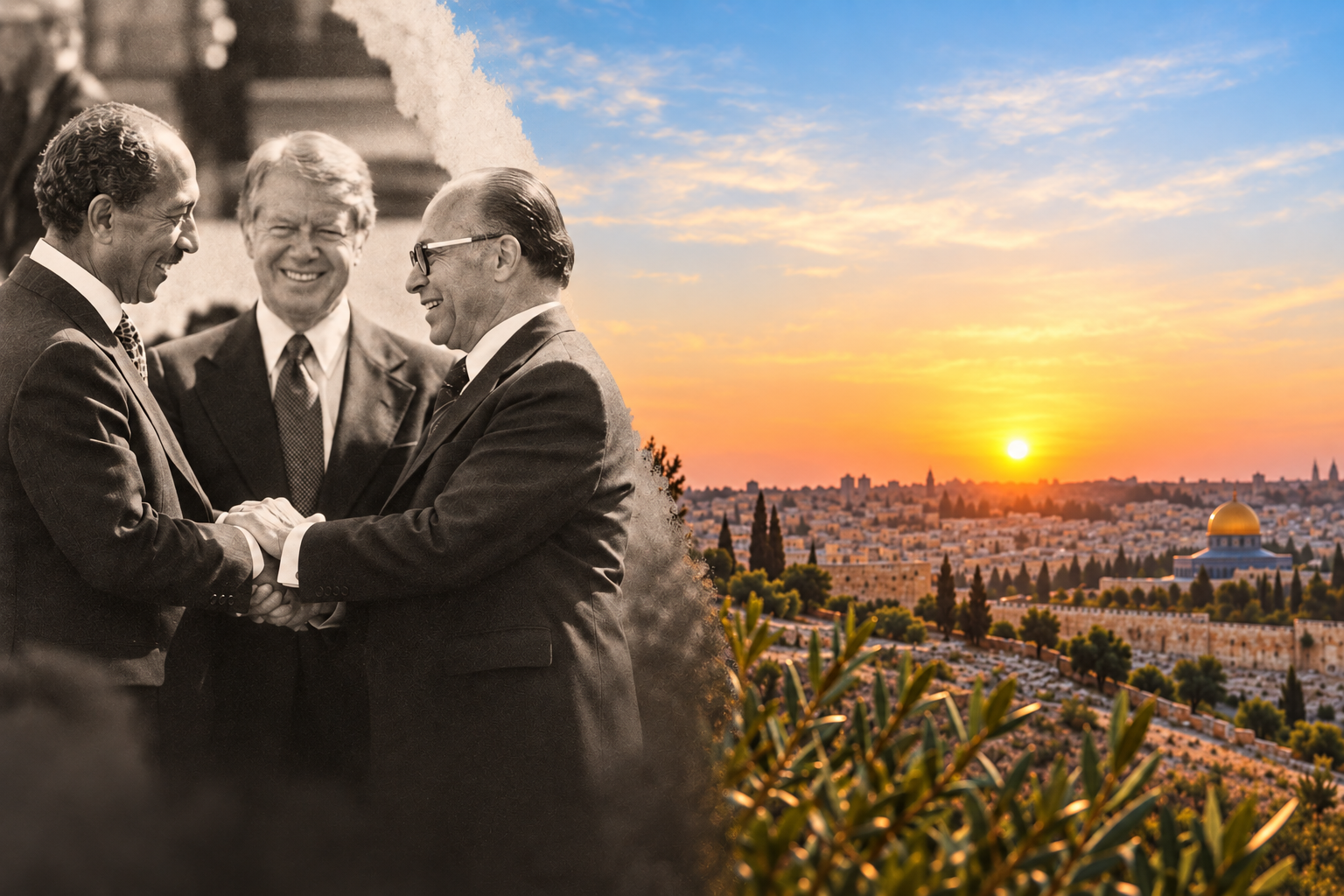
On Yom Kippur, 1973, Egypt, along with Syria, Iraq, Jordan, and Saudi Arabia, surprised Israel and attacked it. For almost a month, the two sides fought. At times it looked like Israel was going to disappear. But the war ended, as all wars eventually do, and Israel went back to a cold animosity with the Arab world. The Yom Kippur War didn't appear to solve anything. It felt like a bloody skirmish in a forever conflict.
Fast forward four years.
On November 19, 1977, Egyptian president Anwar Sadat arrived in Israel, the first Arab leader ever to do so. A year later, Sadat and Israeli president Menachem Begin found themselves with President Jimmy Carter at Camp David and after thirteen days of negotiations created the framework for the first peace plan in Israel's history, formally ending the conflict between Israel and Egypt.
Many books have been written over the decades analyzing what led Sadat to step onto that plane.
He may have felt that diplomacy was the only way to get the Sinai back since war had not worked.
He likely saw after the Yom Kippur war that he would never defeat Israel.
He may have thought that the only way to help his failing economy was to open Egypt to the west and peace with Israel was a tool to do that.
Reconciling with Israel might have been a convenient way for him to show independence from the other Arab nations.
Or, he might have felt cornered. He had just given a speech to the Egyptian parliament where he said offhandedly he would go to Israel to make peace, and Israel, calling his bluff invited him over.
I'm less concerned with the reason than with the fact that if you brought back a report of that visit to any Israeli living four years earlier, in 1973, in the days after the Yom Kippur War, they would have called you insane. They would never have felt further from peace, even though peace was closer than ever.
I often think of the historical miracle of that visit when I look at the trainwreck that is Israeli-Palestinian relations today. To be honest, I've never felt this far from peace. And it takes everything in me to not lose hope. Over these eight years we’ve been together, I've been unwavering in my desire for a two-state solution. It feels to me the only way that Israel can remain both Jewish and democratic. Peace is the only avenue through which Israelis and Palestinians can each find a way to self-determination.
But at every turn it seems someone is undermining that dream, be it Hamas, the settlers, Israel’s right-wing government, the Palestinian Authority, Iran, even the UN.
This year I've found myself in conversations with congregants who have confronted me about my insistence on talking about this impossible seeming future, one where Israelis and Palestinians can live side by side in peace in their own lands. I've been accused of giving my congregation false hope. But I don't think false hope exists. Hope is believing in what is possible, not what is probable. And if the peace between Egypt and Israel taught us anything, it's that we don't know what is possible.
I remain steadfast in my naive, idealistic, maybe even utopian hope for a two-state solution. And that is because I believe that speaking about the seemingly impossible is precisely the job of a synagogue and exactly the role your Rabbi should play.
I'm lucky. I'm not in a position to solve the Middle East crisis. Governments have to have positions on withdrawal timetables and on arms embargos. They must decide when to pull the trigger on a terrorist when civilians are in the area. And they will have to make sacrifices on borders, security, and refugees if there is to be peace.
But I have a role as well. And my role is to help each of you continue to believe, to hope for the unbelievable, to help you imagine a world not yet realized.
Jews are practiced at this. Our prophets were dreamers. In a world of violence and oppression, the prophet Amos implored us to "let justice roll down like waters, and righteousness like an ever-flowing stream" (Amos 5:24). Isaiah had the audacity to imagine that one day "the wolf also shall dwell with the lamb, and the leopard shall lie down with the kid; and the calf and the young lion and the fatling together; and a little child shall lead them" (Isaiah 11:6).
Even when prophesy ended, that expansive, hopeful thinking did not die. For two thousand years, Jews have yearned for the messianic age, an era where peace and tranquility will reign. At times, that era felt far away. But even in the darkness, our ancestors kept their faith.
There is an ancient debate in the Talmud about whether a person is allowed to try to calculate the date that the Messiah will come (Sanhedrin 97b). Quickly, the Talmud concludes that the answer should be no. The Messiah will come, but not on your schedule, and if you try to calculate when, you will likely be wrong, so wrong that in your disappointment you will stop believing all together. Not everything needs to make sense. You don't need to have all the answers. Sometimes, believing is enough, in part because if you believe hard enough you will be open to recognizing it when it happens.
Eventually that messianic openness and hope finds its way into our prayerbook in an adapted version of Maimonides' 13 principles of faith:
I believe with perfect faith in the coming of the Messiah, and though he may tarry, nevertheless, I will still wait expectantly for him each day that he will come.
Today, it feels like the prospect of peace is tarrying. But it doesn't mean that its implausibility should cripple you.
On November 10th, we will be welcoming to TNT, Maoz Inon and Aziz Abu Sarah, both tour guides, one Israeli and one Palestinian, to our congregation to speak about their new book, The Future Is Peace: A Shared Journey Across the Holy Land. The book is a hard but hopeful vision for what a solution might look like for our two peoples. As I was reading the book, I was drawn to an insight shared by Aziz. He says (and I'm paraphrasing): People give me a hard time for working for peace and not coming any closer. But people don't give the same hard time to a cancer researcher who works his whole career to try to cure cancer only to eventually retire without succeeding. Why can't the pursuit of peace be a worthy endeavor on its own regardless of the outcome?
Maoz and Aziz know something special. To borrow a phrase from Hemingway: peace is made gradually, then suddenly. It happens slowly, then all-at-once.
I don't see any sign that we are nearing peace. But it doesn't mean it's not there, somewhere. Like a house that collapses when we can't see the hairline cracks in the foundation, peace happens when we chip away at the facade of hatred, fear, and anger until it all crumbles around us. Maoz and Aziz may not see the fruits of their labor but as bridgebuilders they are creating the circumstances for peace to surprise us.
And they are not alone. Since October 7th we have worked to bring peacemakers from Israel to TNT to show you what it means to chip away at the facade of hate.
I was inspired this past spring to bring the leadership of AJEEC (the Arab-Jewish Center for Empowerment, Equality, and Cooperation) to TNT for a breakfast program. AJEEC works to build bridges in the Negev between Jews and Bedouins, focusing on expanding education and access to healthcare for both peoples. They also created a gap-year program where Jews and Arabs work side by side doing community service, learning leadership skills, and building bonds for the future.
At that breakfast someone asked about whether their work actually moved the needle. In answering that question, the leaders of AJEEC were clear: it takes small acts of connection and compassion to add up to major change. Rather than cite statistics, they told stories, because people launch movements, people heal rifts, and many people are the substance of groundswells.
I bring up these players and organizations because I want you to understand that despite the quagmire we are in, there is movement somewhere. If peace comes all at once, it will be because of the gradual, thankless, Sisyphean work these Israelis and Palestinians are doing. When you feel hopeless, find people like them and lend them your support.
There is a fallacy that one has to begin as friends to solve problems. But earlier this year I had a conversation that showed me that this isn’t necessarily true.
In the spring, we hosted a forum for the two candidates running for the NJ-11 congressional seat. As part of the Q&A someone passed me a card that asked, "How do you expect us to make peace with someone who wants to kill us." I don't remember what the candidate's answer was, though I remember it didn't satisfy me.
What I do remember is a conversation with Jodi Rudoren in the parking lot later, who came up to me and said, "When have we ever made peace with someone who didn't want to kill us first?" Jodi was right. In Israel’s history, every peace deal we have ever signed was with someone who wanted us dead.
Egypt wanted to kill us. We found a way.
Jordan put snipers on the walls of the Old City. We signed that deal in 1994.
The UAE helped the Arab world finance its fight against Israel. Today, Israelis fly directly to Abu Dhabi.
One of my favorite dialogues of the past few years of television comes from the show the diplomat, where former Ambassador Hal Wyler speaks about how peace is made:
Diplomacy doesn’t open doors with a twist of the wrist. Diplomacy never works...Diplomacy is days and nights in a Vienna hotel room, listening to the same empty talking points. Getting trashed at the minibar. It’s getting to “no” over, and over, and over. The answer will be “no,” so don’t stop when you hear it...Diplomacy never works. Until it does...One of the boneheaded truisms of foreign policy is that talking to your enemies legitimizes them. Talk to everyone. Talk to the dictator, and the war criminal...Talk to everyone. Fail, and fail again. And brush yourself off. And fail again. Because maybe…
I'm not in those rooms. But I'm in this room with you. And my job is to help you find the stomach for the long, grueling, journey we are on toward a better future. Rather than reinforce why there can’t be peace because of how hard the slog might seem, I want you ready for it if it ever rears its head.
One of my favorite Talmudic stories surrounds Rabbi Yehoshua ben Levi who meets the prophet Elijah. Not squandering the opportunity, he asks when the Messiah will come. Elijah tells him to go ask the Messiah in person. He's standing at the gates among the lepers. Yehoshua runs to the Messiah and asks, "When will you come?" The Messiah answers "Today."
Yehoshua runs home and waits, but the Messianic age does not begin. Forlorn, he goes looking for Elijah. "I waited" Yehoshua says, "but the Messiah didn't come."
"Ah" says Elijah, "You didn't let him finish his sentence. He was quoting the book of Psalms, 'Today, if you would but heed my voice.'"
Peace comes when we listen hard enough to hear. But if we are so busy doubting it, writing it off, being stuck in disbelief, we won't notice it when it's staring us in the face.
In 1977, Israel was taken by surprise when peace arrived on its doorstep. But the miracle of that moment wasn't just that Sadat got on the plane. It's that the average Israeli hadn't written off the prospect of peace, so when it came, they were able to see it and walk toward it.
So this year, my ask isn't complicated. Don't write it off.
I’ve never been less hopeful, and I’ve never needed hope more. So, I’m going to continue to believe and I hope you will too. I don’t know what the next months or years will bring to Israel, but I do know that it takes no more chutzpah to believe in peace than to believe that it can never happen. Both require us to be sure of an unknown future. So, if I have to convince myself of something, it’s that peace is possible. And maybe, it will surprise us into being.